

This article provides general information about credit card surcharge laws as of June 2026. It is not legal advice. Laws vary by state and change frequently. Before implementing any surcharge or cash discount program, consult with a qualified attorney licensed in your state. We are a software company, not a law firm.
Gym and range owners face the constant challenge of managing costs, and credit card processing fees are a part of that equation. These fees vary widely based on the provider and plan, without a universally fixed rate. To offset these expenses, business owners consider two approaches: surcharging customers who pay with credit cards and offering cash discounts. However, the feasibility of these options depends significantly on state laws. This article delves into the differences between surcharges and cash discounts, providing a state-by-state analysis of what's publicly known as of 2026. Remember, this information is no substitute for legal counsel.
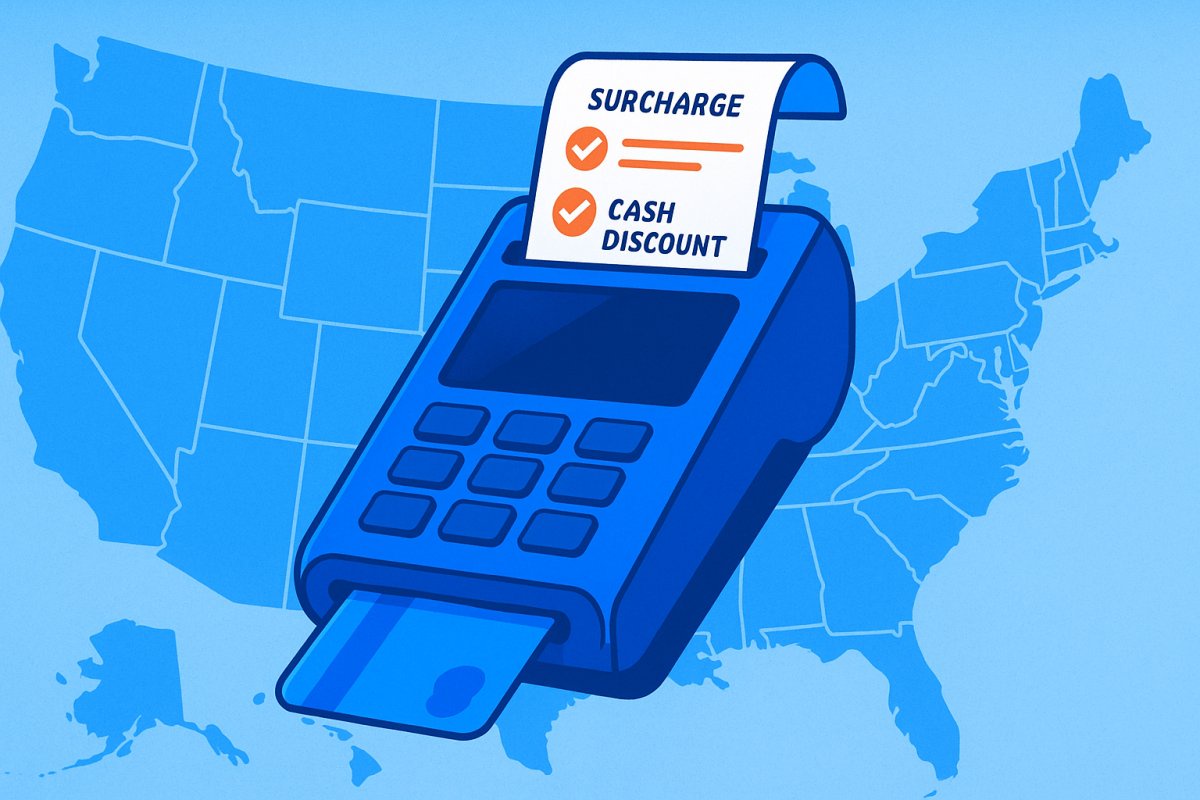
Surcharge vs Cash Discount — What's the Difference?
Surcharge:
- The listed price is the base price; a surcharge is added at checkout for credit card payments.
- Regulations vary by state; some states ban or cap surcharges.
- Federal law prohibits surcharges on debit and prepaid cards.
- Card networks have their own surcharge limits, which may differ from state laws.
- Surcharges must be clearly disclosed before purchase and on the receipt.
Cash Discount:
- The posted price includes card processing costs; a discount is offered for cash payments.
- Generally legal in all states, supported by the Durbin Amendment.
- Key distinction: not charging more for card use, but less for cash use.
- Wyoming caps cash discounts at 5%.
For gym and range owners, understanding these distinctions is crucial. If you're in a state that bans surcharges, a cash discount program might be a viable alternative. However, it's essential to consult legal counsel to ensure compliance with state laws.
State-by-State Surcharge Rules
States Where Surcharging is Currently Prohibited (as of June 2026)
| State | Cash Discount Allowed? | Notes |
|---|---|---|
| Connecticut | Generally yes | Active enforcement reported |
| Massachusetts | Generally yes | Active enforcement reported |
| Maine | Generally yes | |
| Puerto Rico | Generally yes | Territory, not state |
Note: Laws change. Some states have had surcharge bans challenged in court. Always verify current law with local counsel.
States Where Surcharging Has Specific Caps or Conditions
| State | Reported Cap/Condition |
|---|---|
| Colorado | Reported 2% cap, cannot exceed actual processing cost |
| Minnesota | Card brand maximums apply, must disclose total price upfront |
| Nevada | No specific statutory cap, subject to consumer fraud statutes |
| New Jersey | Cannot exceed actual processing expense |
| New York | Flat-rate percentages may be prohibited unless matching exact cost |
| Oklahoma | Prior ban ruled unconstitutional by federal court, enforcement landscape unclear |
| South Dakota | Excessive or undisclosed surcharges may face prosecution |
States with Court-Challenged Bans
| State | Status |
|---|---|
| California | Surcharge ban remains on the books but federal courts have found it unconstitutional on First Amendment grounds. Surcharging with proper disclosure is generally being practiced as of 2026. Legal landscape continues to evolve — consult California counsel. |
| Texas | Similar federal court challenges to prior restrictions. Generally permitted with disclosure. Consult Texas counsel. |
States Where Surcharging is Generally Permitted
Alabama, Alaska, Arizona, Arkansas, Delaware, Florida, Georgia, Hawaii, Idaho, Illinois, Indiana, Iowa, Kansas, Kentucky, Louisiana, Maryland, Michigan, Mississippi, Missouri, Montana, Nebraska, New Hampshire, New Mexico, North Carolina, North Dakota, Ohio, Oregon, Pennsylvania, Rhode Island, South Carolina, Tennessee, Utah, Virginia, Washington, West Virginia, Wisconsin, Wyoming
In all states, surcharges are subject to card network rules and cannot exceed the merchant's actual cost of acceptance.
Federal Rules That Apply in Every State
- Debit card transactions cannot be surcharged (federal law under Dodd-Frank Act).
- Prepaid card transactions cannot be surcharged.
- Card networks require 30 days advance notification before a merchant begins surcharging.
- Surcharges must be clearly disclosed at point of entry, point of sale, and on the receipt.
- Surcharges must appear as a separate line item on the receipt.
- Surcharges cannot exceed the merchant's actual cost of acceptance.
These guidelines are based on publicly available card network rules — specific requirements may vary.
The Cash Discount Alternative
For gym and range owners in states that prohibit surcharges, or who prefer to avoid the complexity of surcharge compliance, a cash discount program might be the solution.
How it generally works:
- Set your posted price to include processing costs (e.g., $103 instead of $100).
- Offer a discount for cash, check, or bank transfer payment.
- Card-paying customers pay the posted price. Cash customers pay less.
Why this approach is different from surcharging:
- The Durbin Amendment supports merchants' right to offer discounts for cash.
- The legal distinction: you are not adding a fee for card use — you are reducing the price for non-card payment.
- The framing matters legally even though the economic outcome is similar.
Practical considerations for gyms:
- Most gym members pay with card via recurring billing — cash discounts mainly affect walk-ins, day passes, and retail POS transactions.
- ACH/bank transfer payments typically carry lower processing fees than card payments and can be incentivized with a small discount.
- Implementation details matter for compliance — consult your attorney on how to structure signage, receipts, and disclosures.
Practical Takeaways for Gym and Range Owners
If you're in a state where surcharging appears to be permitted:
- You may be able to add a surcharge to credit card payments.
- Disclose it clearly and ensure it does not exceed your actual processing cost.
- Consider the member experience — some members will push back.
- Remember: debit cards cannot be surcharged regardless of state.
If you're in a state where surcharging is prohibited:
- Look into a properly structured cash discount program.
- Do not label it as a "surcharge" or "credit card fee."
- Work with an attorney to ensure your specific implementation is compliant.
If you'd rather not deal with it:
- Many gyms simply build processing costs into their membership pricing.
- This avoids compliance complexity and member friction entirely.
- Factor processing fees into your business model as a cost of doing business.
How ManageMemberships Handles Processing
Surcharging is an optional feature toggle in ManageMemberships — you can turn it on or off based on your state's rules. If you're in a state that prohibits surcharging, simply leave it off. Processing fees are built into our subscription pricing so there's no separate surprise fee for your members. Recurring billing runs through Stripe with failed payment retries, automated dunning, and member notifications. For POS transactions (walk-ins, retail, day passes), surcharges or cash discounts can be configured at the register.
Smarter Billing, Better Control, Stronger Tools
Explore calendar billing, subscription management, automated door scheduling, digital waivers, reporting dashboards, and full member portal customization built specifically for gym and studio operators.
This article provides general information about credit card surcharge laws based on publicly available sources as of June 2026. It is not legal advice and should not be relied upon as such. Laws, regulations, and card network rules change frequently. Before implementing any surcharge or cash discount program at your gym or range, consult with a qualified attorney licensed in your state.